Storm Season Emergency Dispatch

Sump Pump Repair in Lansing, MI — Before the Next Storm, or During It

A sump pump spends most of the year doing nothing, and then gets one job on the worst night of the spring: keep up while the rain comes down, the snow melts and the power flickers. That's when most sump pumps in Lansing, East Lansing, Holt and Okemos give out. Our office on Lake Lansing Road answers around the clock, and our trucks carry pumps, float switches, check valves and discharge fittings so a dead pump can usually be swapped the same night.

24/7 emergency sump pump repair, replacement and backup pumps for Lansing, East Lansing, Holt, Okemos and DeWitt.
Answered 24/7 from Lansing · Replacement pumps on every truck · Battery and water-powered backups installed · Price agreed before work begins

Basement Flood Defense

Lake Lansing Road Service Center

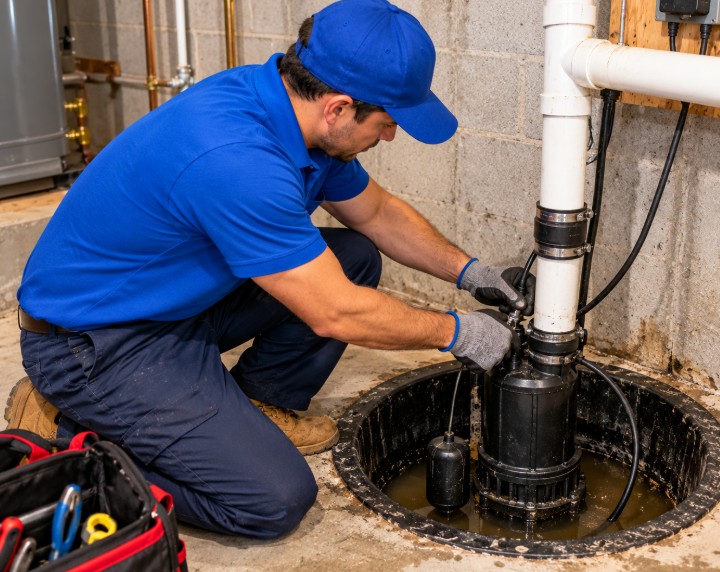
Same-Night Pump Swaps

Trucks stocked with cast iron pumps, dual floats & silent check valves.

Battery & Water-Powered Backups

Pumps continue running even when severe Lansing storms knock out the power grid.

Upfront Guaranteed Pricing

Exact quote approved before any work begins. No surprises after the storm passes.

Water Rising in the Pit Right Now?

What to do depends on why the pump stopped.

The power is out.

If you have a battery or water-powered backup, listen for it running. If not, a portable generator can run the pump through a heavy-duty cord — outdoors only, well away from windows and doors, never in the garage or basement. Don't step into standing water to reach an outlet or the panel; BWL's outage line is 877-295-5001.

The power is on, but the pump is silent.

Check whether a GFCI outlet or breaker has tripped. Then look at the float: it can wedge against the pit wall or the pump's own cord. Freeing it often restarts the pump.

The pump hums but moves no water, or runs and the level keeps rising.

The impeller may be jammed, the discharge pipe may be frozen or crushed outside, or the storm is simply bigger than the pump. Unplug it to keep the motor from burning out, and call us.

Water is coming up through the floor drain instead.

That's sewer water, not groundwater, and a sump pump won't stop it. Stay out of it and see our Drain Cleaning page for what to do.

Why Lansing Basements Depend on a Working Sump Pump

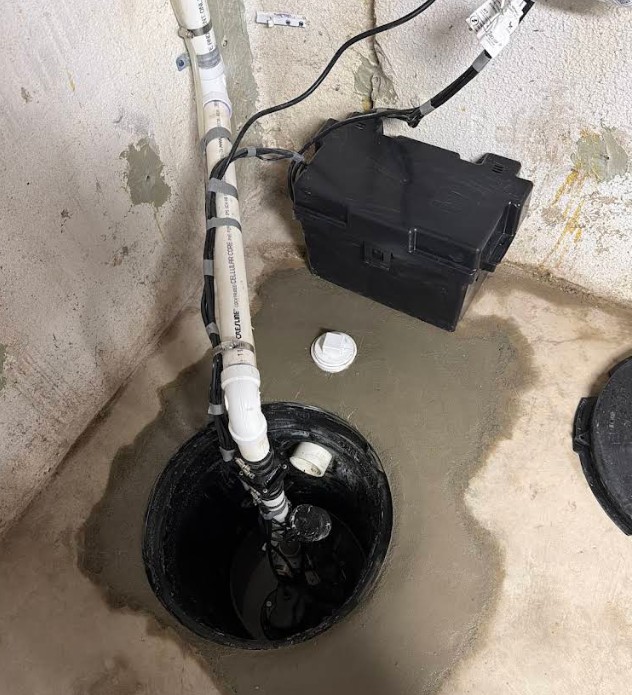
A sump pump isn't a plumbing fixture so much as part of the foundation. Drain tile around the footings collects groundwater before it can push through the basement walls and floor, and carries it to the pit. If the pump quits, that water has nowhere to go but up through the floor.

Mid-Michigan hands those pumps three hard jobs:

Rain on frozen ground. When late-winter rain lands on soil that's still frozen, it can't soak in and runs straight to foundations and sewers. Lansing's public service director told FOX 47 that heavy rain on frozen ground once overwhelmed the city's system so badly that sewage had to be released into the Grand River. Your sump pit sees the same surge.
Spring downpours. After an April 2026 weekend of heavy rain, WILX reported basements flooding across Mid-Michigan. One Lansing homeowner at the bottom of a hill described his street turning into a lake in every heavy rain, and said an earlier storm had cost him more than $30,000.
Storms that take the power with them. The same storms that fill pits cut electricity. One 2025 storm left more than 17,000 BWL customers without power at its peak, according to WLNS. A pump without power is a pump that isn't running.
That combination is why we treat a dead sump pump during a storm as an emergency, and why we push hard for a backup.

What Your Pump Is Telling You

It Won't Run

  • Float stuck or tangled. Vertical floats ride on a rod and can stick with grit; tethered floats swing and catch on the pit wall, the cord or a backup pump. Repositioning or replacing the switch fixes most no-start calls.
  • Tripped GFCI or breaker. A pump that trips it repeatedly has a failing motor or a wet cord, not a fussy outlet.
  • Burned-out motor. Old age, or a pump that ran dry or nonstop until it overheated. Replacement.

It Runs, but Not Right

  • Runs and runs. Groundwater may really be that high in a wet spring. If it keeps running after the pit is empty, the float is stuck in the "on" position, or the check valve has failed and the same water keeps draining back into the pit.
  • Turns on and off every minute or two. Short-cycling — a small pit, a float set too tight, or a leaking check valve. It wears out the switch and motor fast.
  • Hums with no flow. A jammed impeller, a clogged intake screen, or an airlock in the discharge.
  • Runs, but the pit keeps rising. The pump can't push the volume up and out — undersized for the inflow, a worn impeller, or too much lift and pipe for its rating.
  • Bang when it shuts off. Water hammer from the check valve slamming. A quiet or spring-loaded check valve fixes it.
  • Grinding or rattling. Debris in the impeller or failing motor bearings.

The Pump Is Fine, but There's a Problem

  • Frozen discharge line. The pump runs, but the water has nowhere to go and comes back down. See the discharge section below.
  • Water pouring out near the foundation. A discharge that dumps right next to the house sends the same water back down to the drain tile, so the pump keeps re-pumping it.
  • Smell from the pit. A pit with no lid, or a lid that doesn't seal, lets damp, musty basement air circulate. A sewage smell points to a drain problem, not the sump.
  • Pit stays dry while the floor gets wet. The drain tile may be clogged, collapsed or not connected to the pit. That's a drainage issue, not a pump issue, and we'll tell you so.

Fix It or Replace It?

A switch, a check valve, a cord or a clogged intake is worth repairing on a pump that's a few years old. Once the motor is failing, or the pump is reaching the 7-to-10-year range most manufacturers and plumbers use as a working life, replacing it costs about the same as a serious repair and resets the clock. A pump that has already let the basement flood once doesn't get a second chance from us — we'll recommend replacing it.

What We Look At Before Choosing a New Pump

• How hard it works. A pump that runs a few times a year and one that runs every few minutes all April need different builds. We look at the pit, the water stains and your history before sizing it.
• Lift and pipe run. Every foot the water climbs, and every elbow along the way, cuts what the pump can move. A pump is chosen for its flow at your actual lift, not the number on the box.
• Submersible or pedestal. Submersibles sit in the pit, run quieter and handle heavy inflow; pedestals keep the motor above water and suit narrow, shallow pits. For a basement that takes on real water, we usually recommend a cast-iron submersible.
• The switch. A vertical or electronic switch needs less room than a tethered float and is less likely to snag — important in a small pit or one shared with a backup pump.
• The pit itself. Model plumbing codes call for a sump pit at least 18 inches across and 24 inches deep, with a removable cover. A pit smaller than that makes even a good pump short-cycle. Enlarging or replacing the basin is sometimes the real repair.
• The details that fail first. A new check valve every time, a union so the pump can come out without cutting pipe, a discharge pipe no smaller than the pump's outlet, a sealed lid, and a high-water alarm.
When a basement floods again and again, we'll say so if a bigger pump won't fix it. Grading, gutters or drain tile repair may be what's needed, and pumping harder just treats the symptom.

Backup Pumps: Which One Fits Your House

A backup pump covers the two ways a primary pump lets you down: the power goes out, or the pump itself fails. Each type handles those differently.

Battery Backup

A second pump in the same pit, running off a sealed battery with its own charger and alarm. It kicks in when the water rises above the main pump's "on" level, whether the main pump lost power or just died.

  • Good for: any house, including homes on a private well.
  • Limits: the battery holds a set number of pump cycles, so a long outage in a wet week can drain it. Batteries wear out and need replacing every few years. Have the battery and charger tested at least once a year.

Water-Powered Backup

This type uses the pressure of your city water to pull water out of the pit. There's no battery to run down, so it keeps working through a multi-day outage as long as the water supply has pressure.

  • Good for: homes on BWL or East Lansing city water where outages are the main worry.
  • Michigan requires extra protection. Sump water is contaminated, and the backup connects it to your drinking water. Michigan requires a reduced-pressure zone (RPZ) backflow preventer on these systems, and only models approved by the state through its certificate-of-acceptability process may be used. An RPZ is a testable device; BWL's rules make the customer responsible for installing, testing and maintaining backflow devices on its system.
  • Costs: it uses roughly two gallons of drinking water for every gallon it removes, according to Ann Arbor's utility guidance. That's fine for emergencies, but it isn't meant to run every day.
  • Won't work on a well, because the well pump stops when the power does.

Generator

A portable generator can run the main pump through an outage if someone is home to start it and keep it fueled. Run it outdoors only, far from doors and windows. A permanently installed standby generator with a transfer switch is the hands-off version; that's an electrician's job.

High-Water Alarm

Whatever backup you choose, add an alarm. A Wi-Fi model texts your phone when the water rises above normal — the difference between a damp floor and a flooded one when you're away.

Where the Water Goes — and Why It Matters in Winter

Never Into the Sanitary Sewer

A sump pump discharging into a laundry tub, floor drain or sewer cleanout is a code violation — model plumbing codes forbid sending groundwater into the sanitary system — and nearby Mason's city code bans it outright. It also hurts your own neighborhood. Parts of older Lansing still have combined storm and sanitary sewers, and every gallon of groundwater pumped into the sewer is a gallon that helps fill those pipes during a storm and push sewage back into basements. If your pump drains inside the house, we'll reroute it outdoors.

Outside, and Far Enough

The outlet should drop water where it flows away from the house, not back toward the foundation and down to the drain tile. Discharging onto a neighbor's yard, a sidewalk or the street invites ice and complaints in winter. Where a storm sewer connection is available and allowed, it's often the cleanest option; we check with the local public works office first.

Frozen Discharge Lines

This is the Lansing winter sump problem. The pump runs, the outside pipe is frozen solid, and the water has nowhere to go. A pump pushing against a frozen line overheats, and the pit overflows anyway. We prevent it by:

  • Sloping the outdoor pipe so it drains completely after each cycle, with no low spots for water to sit and freeze.
  • Adding a freeze-relief fitting near the house that lets water escape at the wall if the line downstream freezes.
  • Burying the line below the frost to a pop-up emitter, or running it to an open discharge point that can't ice over.
  • Keeping flexible hoses for summer only — they kink, sag and freeze.

A Sump Pump Calendar for Mid-Michigan

Late February to March, before the thaw. Lift the lid and slowly pour a five-gallon bucket of water into the pit. The pump should start on its own, empty the pit and shut off cleanly. Then go outside and make sure the discharge outlet isn't buried under a snowbank or capped with ice.
April to May, the busy season. Listen for the pump during heavy rain. If it seems to run constantly, check that the outlet is carrying water well away from the house. Clean the intake screen if the pit collects silt.
Summer storms. Test the backup: unplug the main pump and let the water rise to the backup's switch. Check the battery's date and the charger light.
Fall, before the first hard freeze. Disconnect and store any summer hose extension, clear leaves from the outlet, and confirm the freeze-relief fitting is in place.
Any time. A new noise, a pump that seems to run more than last year, or rust on the discharge pipe are worth a call before they become a 2 a.m. call.

Paying for It: City Help and Your Policy

Lansing Will Share the Cost After a Sewer Backup

The City of Lansing's Basement Backup Protection Program (B2P2) partly reimburses residential owners for a backflow prevention valve, a sump pump system, or both. It's meant for homes that have already been flooded by the public sewer. After the April 2026 storms, the city's public service director explained the formula to WILX: the city covers the first $1,000 and 75% of the next $5,000, up to $4,750. You must be current on property taxes, and the program doesn't cover private sewer lateral problems such as roots or a crushed pipe. Call Lansing Public Service at (517) 483-4456 before the work starts to confirm eligibility and what paperwork the city needs. East Lansing residents with backups should contact that city's Department of Public Works, which is mapping high-risk flood areas.

Read the Water Section of Your Policy

A standard Michigan homeowner policy usually leaves out water that backs up through a drain or overflows from a sump pump. That coverage typically comes as a separate endorsement with its own limit. Michigan's Department of Insurance and Financial Services suggests asking your agent about it. If you've just put in a new pump or backup, ask whether that changes your price.

Sump Pump Questions Lansing Homeowners Ask

Will you come out at night during a storm?

Yes. A failed pump with water rising in the pit is exactly what our overnight dispatch is for. We bring replacement pumps on the truck, so the fix doesn't have to wait for a store to open.

How long does a sump pump last?

Most give 7 to 10 years of service, less if they run constantly. Age alone isn't a reason to panic, but a pump in that range deserves a test before every spring.

My pump runs even when it hasn't rained. Is that normal?

It can be. Groundwater stays high for weeks after snowmelt. But if it runs with an empty pit or every minute or two, the switch or check valve is likely at fault.

Should there be water sitting in the pit?

A few inches below the pump's "on" level is normal. A bone-dry pit all year can mean the drain tile isn't reaching it; a pit that's always near the top means the pump isn't keeping up.

Can I drain my sump pump into the floor drain or laundry tub?

No. Groundwater isn't allowed in the sanitary sewer, and in older Lansing neighborhoods it adds to the sewer overload that backs up basements. We'll reroute it outdoors.

Is a water-powered backup legal in Michigan?

Yes, if it's a state-approved model installed with an RPZ backflow preventer that's tested as required. It won't work on a private well.

Does the City of Lansing help pay for a sump pump?

If your home was flooded by the public sewer, the Basement Backup Protection Program can reimburse part of a sump pump system or backflow valve — up to $4,750. Call Lansing Public Service at (517) 483-4456 before work starts.

Can I replace a sump pump myself?

A straight swap of an identical pump is a common DIY job. Call a plumber if the pit is too small, the discharge needs rerouting, you want a water-powered backup (it ties into drinking water), or the old pump failed in a way you can't explain.

Scroll to Top