
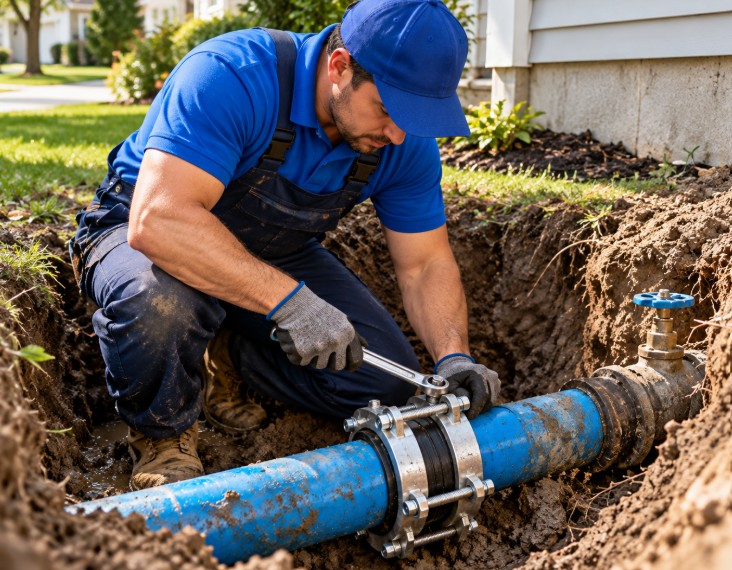
Main Water Line Repair in Lansing, MI — Found, Fixed, and Sent to the Right Owner
Water bubbling up in the yard, a sudden drop in pressure, a meter that never stops spinning, or water pouring in where the line comes through the basement wall — these all point to the main water line. For main water line repair in Lansing, MI, call our Lake Lansing Road office any hour. We find exactly where the leak is, tell you whether it's your pipe or the utility's, and repair or replace your section — by trenchless boring where the yard allows it.
That second step matters here more than almost anywhere. In much of the Lansing area, the Lansing Board of Water & Light (BWL) owns the buried line all the way to your meter, so a leak in the yard may be BWL's to fix at no cost to you. We'll tell you straight.
Main Water Line Leaking Right Now?
- 1 Shut the water off at the main valve — usually right beside the water meter, inside the basement near the front foundation wall. If the leak is between the wall and that valve, you can't stop it from inside; go to step 3.
- 2 Kill power to anything getting wet if water is near outlets, a furnace or the electrical panel — only if you can reach the breaker without standing in water.
- 3 Call BWL at (517) 702-6490 if water is coming up in the yard, the street or the sidewalk, or through the foundation before the meter. Only BWL may operate the curb stop outside, and that section of pipe is BWL's.
- 4 Call us for anything after the meter, for a line you own (see the next section), or if you're not sure. We'll come find the leak.
- 5 Take photos of water, damage and the meter reading for insurance.
Follow the Pipe: From the Street to Your Shut-Off Valve
On a typical BWL home with the meter in the basement, here's who owns each stretch of pipe, and what tends to go wrong there.
When the Buried Line Is Yours
-
•
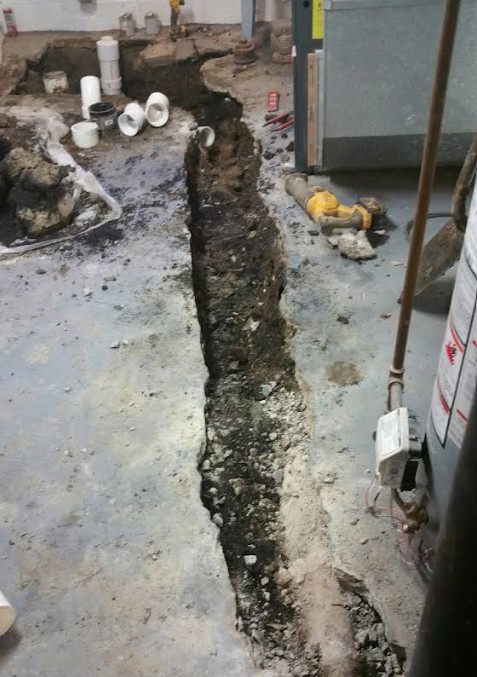
Outdoor meter pit. Where BWL set the meter in a pit near the property line, the pit and the pipe from it to the house belong to the owner.
-
•
East Lansing city water. The City owns the curb stop; the owner owns the pipe from there to the meter, and the City inspects an owner's replacement.
-
•
Private well. Every foot from the well to the house is yours.
-
•
Other utilities around Lansing. Rules vary — your water bill names your utility, and we can check before quoting.
How a Failing Water Service Gives Itself Away
Outside
A buried leak feeds the soil above it. Look for a stripe of grass that stays greener or spongier than the rest of the lawn, running between the street and the house. In winter it's the reverse: a patch where snow melts first or the ground never firms up. After a spring thaw, a slight dip along that route can mean a leak has been washing soil away for a while.
At the Foundation
Where the pipe comes through the basement wall, look for a dark, damp ring in the concrete, a white chalky crust, or a trickle down the wall. Water collecting at the floor drain BWL requires beside the meter can mean the meter coupling or the outlet valve is leaking, rather than the buried line.
At the Faucets
Pressure that has faded over years, everywhere in the house, usually means old galvanized pipe narrowing with rust inside. Pressure that drops all at once is a break.
On the Bill
BWL's smart meters log usage daily. Usage that never falls to zero, even overnight, means water is going somewhere. Our Leak Detection page explains how to use your meter to tell a buried leak from one inside the house.
What Breaks Water Lines Around Lansing
The foundation wall
The house sits on footings below the frost line, but the soil in the yard heaves and settles with every freeze and thaw. The service line is fixed at the wall and free in the ground, so the stress concentrates where the pipe enters the house. That's why leaks so often show up near the foundation.
Shallow spots
A line laid at proper depth can end up too shallow when a yard is regraded, or when an addition, porch or garage slab is built over the old route. Those are the sections that freeze in a hard January.
Galvanized pipe on the owner's side
Where the owner owns the buried line — East Lansing city water, meter pits, older outbuilding feeds — galvanized steel is still out there. It rusts from the inside, choking the flow before it finally leaks at a threaded joint.
Old interior mains
Even on BWL properties, where the buried pipe is BWL's, the main line inside the basement is often original. A seized gate valve, galvanized nipples at the meter, and a corroded tee feeding the water heater are common repairs.
Shovels and augers
Fence posts, sprinkler systems, tree planting and deck footings find water lines all the time. MISS DIG marks utility-owned lines, but not private ones, such as an owner-owned line from a meter pit or a feed to a detached garage. We trace those with a locator before anyone digs.
How We Repair or Replace a Water Line
Every job starts by pinning the leak to a spot within a few feet, so the hole goes in the right place. Our Leak Detection page covers how we do that.
Repair Options
| Method | When it fits | Trade-offs |
|---|---|---|
| Spot repair cut out the bad section, install a new piece with code-approved couplings | One leak in a line that's otherwise sound | Cheapest and fastest; won't help a line that's failing everywhere |
| Open-trench replacement | Short runs, lines under open lawn, or when bends and obstacles rule out trenchless | Simple and inspectable; the whole route is dug and restored |
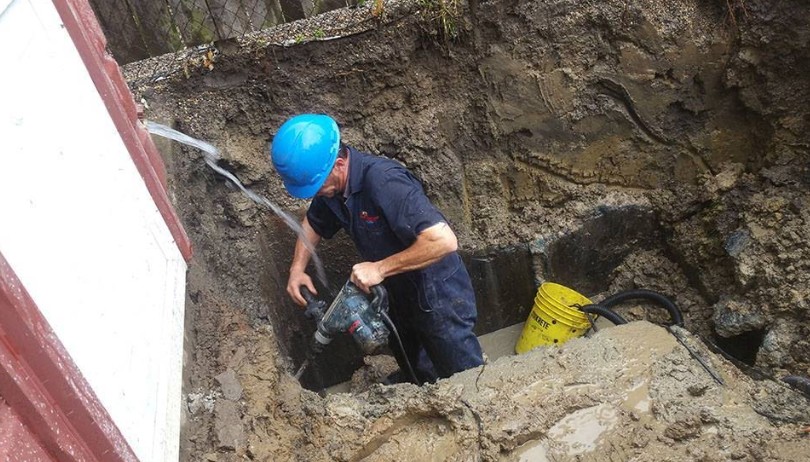
| Directional boring or pneumatic piercing (trenchless) a new line is pushed or pulled through the ground on a new path between a pit at the house and a pit at the curb or meter pit | Replacing a line under a driveway, mature trees, landscaping or a sidewalk | Two small pits instead of a trench; needs room for the pits and accurate locates |
| Pipe pulling or bursting (trenchless) the old pipe is split or pulled out and the new one follows the same path | Old galvanized or copper lines where the original path is clear | Reuses the route; not possible where the old pipe is encased or has many bends |
| Epoxy lining coating the inside of the existing pipe | Some interior lines and commercial systems | Must be certified for drinking water; we rarely recommend it for buried residential service lines |
Materials We Use
Need a New or Larger Line on BWL Water?
A kitchen and bath addition, a second story, or a fire sprinkler system can outgrow an old service line. On BWL water you have two routes:
-
•
BWL installs it and bills you. Its 2024 schedule lists $3,200 minimum for a trenched curb-box-to-building line and $4,500 minimum bored, plus restoration. Work from December 15 to March 31 carries a winter construction charge.
-
•
A BWL-approved contractor installs it under BWL's Customer Choice Program, with BWL approving plans and inspecting before the line is handed over to BWL to own.
Lead and Galvanized Lines: What Michigan Law Says
BWL replaced every one of its 12,150 active lead service lines with copper between 2004 and 2016 — one of only two large U.S. utilities to finish the job, along with Madison, Wisconsin. BWL says it continues corrosion-control treatment to keep lead from leaching out of older plumbing inside homes.
Michigan's 2018 Lead and Copper Rule — the strictest in the country — requires every water utility to replace all lead service lines by January 1, 2041. It includes the section on private property, it's paid for by the water utility rather than the homeowner, and partial replacements are banned. Galvanized lines that are or ever were connected to lead must be replaced too. If your line is lead or galvanized and you're not on BWL water, call your utility before paying for replacement yourself.
Is My Pipe Lead or Galvanized?
Look at the pipe where it comes through the basement wall, before the meter.
Building a Water Line That Lasts Here
1 Depth
The Michigan Plumbing Code puts water service at least 6 inches below the frost line, and Michigan's frost depth is 42 inches, so a new line goes down at least 4 feet. Where an existing line is shallower — under a regraded bed or an old porch — we lower it or move it rather than reconnect to a known freeze point.
2 Distance from the sewer
Water and sewer lines are kept apart in the trench, with the water line above the sewer where they cross, so a sewer leak can't contaminate drinking water.
3 Bedding and backfill
The pipe rests on sand or fine fill, not on stones that wear through it as the ground moves.
4 The wall penetration
The new pipe goes through a sleeve and is sealed, so the house can settle without shearing the pipe and groundwater can't follow it into the basement.
5 Inspection before backfill
Water service work needs a plumbing permit, and the inspector sees the pipe and a pressure test before the trench is closed. On East Lansing water, the City also inspects owner replacements.
6 Winter work
Frozen ground is slower and costlier to dig, so outside a true emergency, owner-side replacements are best scheduled from spring to late fall. For an active leak in January, we repair it then, and plan any full replacement for after the thaw.