
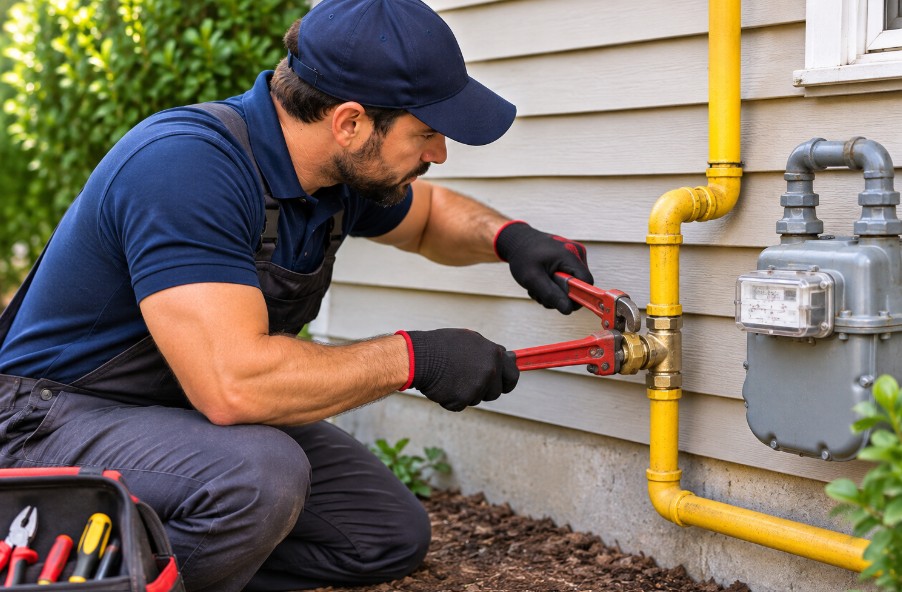
Gas Line Repair in Lansing, MI
Licensed and insured gas line plumbers who find the leak, fix the pipe and handle the permit, for older Lansing homes and new ones alike.
The gas piping in a Lansing house works hard. It feeds a furnace through roughly seven months of heating season, sits in basements that are often 70 to 100 years old, and connects to an outdoor meter that spends the winter under snow and ice. When that piping starts to fail, you want someone who knows both the trade and the local conditions.
Lansing Emergency Plumber repairs, replaces and installs natural gas and propane piping across Greater Lansing. Our gas technicians are licensed for fuel gas piping work in Michigan, and the company carries full liability insurance. We pull the required permit, pressure-test every repair and stay until the work passes inspection.
Gas Line Services We Handle
- Gas leak detection, including hard-to-find leaks in walls, crawlspaces and buried yard lines
- Repair or replacement of corroded, damaged or outdated gas pipe
- New gas lines for ranges, dryers, water heaters, furnaces, boilers, fireplaces, generators and outdoor kitchens
- Code-required pressure tests for sales, remodels and new appliances
- Shut-off valve, flex connector and sediment trap replacement
- CSST (yellow flexible gas tubing) inspection and bonding corrections
Smell Gas in Your Lansing Home? Do This First
A rotten-egg or sulfur smell is the warning your utility added on purpose. Natural gas has no odor of its own, so Consumers Energy adds one so leaks can be noticed. Treat that smell as a leak until a professional says otherwise.
These steps follow Consumers Energy's published safety guidance:
-
1
Get everyone out now, including pets. Leave doors open behind you if that doesn't slow you down.
-
2
Don't create a spark on the way out. Don't flip light switches, unplug anything, use the garage door opener, light a match or start a car parked nearby. Wait to use your phone until you're outside.
-
3
Don't hunt for the leak and don't try to shut off gas valves or appliances. Consumers Energy specifically asks customers not to do this during a suspected leak.
-
4
From a safe distance, call 911 first, then Consumers Energy at 800-477-5050. The gas emergency line is answered 24/7, and the utility responds to leak calls at no charge.
-
5
Stay out until a Consumers Energy employee tells you it is safe to go back in.
-
6
Then call a licensed gas line plumber. The utility makes the situation safe. If the leak is on your side of the meter, the repair is yours to arrange, and that is where we come in.
Hit a buried line while digging? Move away from the area, call 911, then call the utility. Don't try to crimp, cover or bury a damaged pipe.
Utility Pipe or Your Pipe? Where Responsibility Changes
The gas meter is the dividing line. Consumers Energy owns and maintains the main in the street, the service line to your house and the meter itself. Everything on the outlet side of the meter is customer-owned piping, and keeping it safe is the property owner's job.
| Section of the gas system | Who owns and repairs it | Who to call |
|---|---|---|
| Gas main under the street | Consumers Energy | Consumers Energy |
| Service line from the main to your meter | Consumers Energy | Consumers Energy |
| Meter and pressure regulator | Consumers Energy | Consumers Energy (don't tamper with or move it) |
| Pipe from the meter outlet into the house | Property owner | A licensed gas piping contractor |
| Interior piping, valves and appliance connectors | Property owner | A licensed gas piping contractor |
| Buried "yard lines" to a detached garage, shop, grill, pool heater or second building | Property owner | A licensed gas piping contractor |
Two details catch Lansing homeowners off guard:
- Buried customer lines are easy to forget. Federal pipeline rules require gas utilities to notify customers who own buried piping that the utility does not maintain it. A steel yard line to a detached garage, common on older Lansing lots, can corrode for decades with no one checking it.
- MISS DIG 811 won't mark your private lines. Calling 811 gets the utility's lines marked for free, but MISS DIG states that private lines, such as a gas line to a grill, shed, pool or detached garage, are not marked. Those need a private locator before you dig.
If you're not sure which side of the meter a problem is on, call us. We can tell you within a few minutes on site, and we'll coordinate with Consumers Energy when work touches both sides.
Warning Signs of a Gas Line Problem
Some gas line problems are loud and obvious. Many are not. These are the signs we ask Lansing homeowners to watch for, roughly from most to least urgent.
Urgent Signs: Leave and Call for Help
- A rotten-egg or sulfur smell, even a faint one that comes and goes
- A hiss, whistle or roar near gas piping, an appliance or the meter
- Bubbles rising through a puddle, a flooded window well or wet soil near a buried line
- Dust or dirt blowing up from the ground for no visible reason
Signs That Need an Inspection Soon
- A strip of dead or yellowed grass over the path of a buried line, especially one that persists after rain
- Burner flames that are yellow or orange instead of mostly blue, or soot around an appliance
- A pilot light or burner that keeps going out
- A gas bill clearly higher than the same month last year, with no change in weather, household size or appliances
- Rust, flaking or green corrosion on exposed pipe, unions or the meter riser
- Old flexible appliance connectors that are kinked, uncoated brass or older than the appliance they feed
Can't rely on your nose? Some people have a reduced sense of smell, and the odor can be masked by cooking, paint or a damp basement. A plug-in natural gas detector is a useful backup. Consumers Energy notes that a gas detector does not replace a carbon monoxide alarm unless it is designed to detect both.
How Our Gas Line Repair Works, Step by Step
Good gas work is mostly method. Here is what you can expect from the first call to the final relight.
-
1
Phone triage. We ask what you're noticing and where. If you describe an active gas smell, we'll tell you to leave and call 911 and Consumers Energy first. Your safety comes before booking an appointment.
-
2
Safety sweep on arrival. Your technician checks the air with a combustible gas detector and a CO meter before starting work, starting at the meter and moving through the basement and appliance areas.
-
3
Finding the leak. We combine an electronic gas sniffer, a bubble solution on suspect joints and a meter test with every appliance off. If the meter still registers flow with everything off, gas is going somewhere. Buried yard lines are isolated and tested on their own.
-
4
A clear explanation and a written price. You'll see what we found, usually with photos, and get repair and replacement options with a written price before any work starts.
-
5
Permit. Most gas piping repairs and every new line need a mechanical permit. We pull it with the City of Lansing's Building Safety Office or with your own city or township building department if you're outside the city limits.
-
6
The repair. We isolate the affected section, replace damaged pipe and fittings with code-approved materials, and correct problems we find along the way, such as missing sediment traps, unsupported runs or unsleeved wall penetrations.
-
7
Pressure test. The repaired piping is tested under pressure on a gauge for the time the code and the local inspector require. A system that loses pressure doesn't get turned back on.
-
8
Inspection. The city or township inspector checks the work. We schedule it and meet the inspector when required.
-
9
Restoring service. We purge the air from the lines, relight every pilot, check each burner flame and take CO readings at the appliances. If Consumers Energy shut off or locked your meter, we coordinate with them to restore service.
-
10
Records for you. You get the test results, permit information and photos. These are useful when you sell the house or file an insurance claim.
Repair or Replace? How We Decide
We repair when the problem is isolated and the surrounding pipe is sound. We recommend replacement when fixing one spot would just move the failure to the next joint. We'll always show you why.
When a Repair Makes Sense
- One fitting, valve, union or connector is leaking and the pipe around it is in good shape
- A single section was physically damaged, for example by a nail, a vehicle or a shovel
- The system passes a pressure test once that one spot is fixed
When Replacement Makes Sense
- Corrosion shows up in several places, or the pipe is pitted where it passes through a wall or floor
- The line is galvanized or has been patched before
- A buried steel yard line is leaking. Where one spot has corroded through, others usually aren't far behind
- The pipe is too small for the appliances you have now or plan to add
- CSST is damaged, or the system can't be bonded properly as installed
What we don't do: we don't use tape, wraps or epoxy putty as a permanent fix on a leaking gas line. A leaking joint gets remade or replaced, then tested.
Gas Piping Materials Used in Lansing Homes
| Material | Where it's used | Strengths | Watch-outs |
|---|---|---|---|
| Black steel (threaded) | Most interior piping in older and many newer homes; meter risers | Very durable indoors and easy to inspect | Rusts if wet; threaded joints are the usual leak points |
| Galvanized steel | Found in some older Lansing homes | Rust-resistant outside | Coating can flake inside and clog controls; often replaced during repairs |
| CSST (yellow flexible tubing) | Newer homes, additions, appliance runs | Fewer joints, faster install, fits through framing | Must be electrically bonded; vulnerable to nails and screws |
| Polyethylene (PE) | Buried outdoor lines only, such as to a garage, grill or generator | Doesn't corrode underground | Not allowed exposed above ground; needs a tracer wire so it can be found later |
| Copper | Uncommon for natural gas here | Corrosion-resistant | Allowed only where code and the gas supplier permit it; we confirm before using it |
| Flexible appliance connectors | Final connection to a range, dryer or water heater | Lets an appliance move slightly | Must be the right length and rating; never reused when an appliance is replaced |
Gas Line Installation and Related Services in Lansing
Many repair calls turn into "while you're here" projects. Every new line starts with a load calculation: we add up the BTU rating of every appliance on the system, measure the run length and size the pipe so each appliance gets full pressure when they all run at once.
- Kitchen ranges and cooktops, including converting an electric kitchen to gas
- Gas dryers, with a dedicated shut-off valve and the correct connector
- Water heaters, tank and tankless. Tankless units often need a larger line than the old tank had. For problems with the heater itself, see our water heater repair service
- Furnaces and boilers, including the gas side of a replacement installed by your HVAC contractor
- Standby generators. A whole-house generator draws a lot of gas at once, and an undersized line is a common reason they fail to carry the load during an outage
- Outdoor kitchens, grills, fire pits and patio heaters, with buried PE lines and a tracer wire
- Gas fireplaces and inserts, including conversions from wood
- Garage, shop and pole-barn heaters fed by a buried yard line
- Capping and decommissioning lines when you switch an appliance to electric, so no live stub is left behind
- Pre-sale and pre-purchase gas inspections, including pressure tests requested by buyers, lenders or inspectors
- Additions and remodels, including coordinating with Consumers Energy if the meter has to move
Permits, Codes and Inspections in the Lansing Area
Gas piping is one of the most regulated trades in a house, and for good reason. Here is how it works locally.
Which code applies. Michigan's current mechanical code and the International Fuel Gas Code it references, both based on the 2021 editions, took effect statewide in March 2024. Homes also follow the fuel gas provisions of the Michigan Residential Code. These set the rules for pipe sizing, approved materials, valve locations, sediment traps, support spacing, CSST bonding and pressure testing.
Who issues the permit. It depends on where the property sits, not on the mailing address:
- Inside Lansing city limits, mechanical permits come from the City of Lansing's Building Safety Office at 316 N. Capitol Ave.
- Many homes with a "Lansing, MI" address are actually in Lansing Township, Delta Township or Delhi Township. East Lansing, Meridian Township and other nearby communities run their own building departments too.
- We confirm the right jurisdiction for your address before we start, so the permit and inspection go to the right office.
Who is allowed to do the work. In Michigan, installing, altering or servicing fuel gas piping requires a mechanical contractor license with the right work classification. A plumbing license alone doesn't cover gas piping. You can check any contractor's license with the state's online license lookup from the Department of Licensing and Regulatory Affairs (LARA).
Why permits protect you. A permit brings an independent inspector to check the work and the pressure test. That record matters if you sell the house, refinance or file an insurance claim. It's also your assurance that a gas line hidden behind a finished wall was tested before it was covered.
What Affects the Cost of Gas Line Repair in Lansing
No honest contractor can price a gas leak over the phone, because the price depends on where the problem is and what we find around it. For a rough sense of scale, national cost guide Fixr puts a typical gas line repair at $150 to $700, with excavation for a buried leak adding roughly $1,000 to $1,500. Lansing jobs vary on either side of those numbers. You'll always get a written price from us before work begins.
| Factor | Why it changes the price |
|---|---|
| Location of the problem | An exposed basement joint is quick. Pipe inside a finished wall, ceiling or crawlspace takes more labor and patching. |
| Buried vs. interior | Yard lines require locating, digging and backfill. Frozen ground in January makes digging slower and sometimes forces a temporary fix until a thaw. |
| Pipe size, material and length | Larger diameters and longer runs cost more. Replacing galvanized or corroded steel often means redoing a whole branch. |
| Code corrections found on site | Missing sediment traps, unbonded CSST or unsupported pipe have to be fixed before the system can pass inspection. |
| Permit and inspection | Fees are set by the city or township, and an inspection visit may add a return trip. |
| Timing | After-hours or holiday emergency work costs more than a scheduled visit. |
| Restoration | Drywall, flooring, concrete or landscaping repair is separate from the gas work. Tell us your preference up front. |
| Utility coordination | Jobs that involve the meter or service line require scheduling with Consumers Energy. |
Ways to keep the cost down: clear a path to the meter and the work area, mention any finished spaces the pipe runs through, and bundle work. If you're planning a new range or generator, adding it during a repair saves a second permit and trip.
A Seasonal Gas Safety Checklist for Lansing Homeowners
None of these require tools or touching the gas piping itself. They're the habits that catch problems early.
| Season | What to do |
|---|---|
| Fall (before heating season) | Book the yearly furnace inspection. Test CO alarms and replace any older than the maker's stated life. Walk the basement and look at exposed gas pipe for rust or green corrosion. |
| Winter | After every storm, brush snow off the meter and regulator by hand or with a broom. Knock down icicles above the meter. Keep furnace and water heater vent pipes clear of drifts. Keep a clear path to the meter for responders. |
| Spring | Call MISS DIG 811 three business days before any digging. Have private yard lines located before fence, deck or garden work. After any basement water, have flooded gas appliances checked before using them. |
| Summer | Watch for dead strips of grass over buried lines. Check the bonding clamp on any yellow CSST if you've had electrical work done. Plan outdoor gas projects (grills, fire pits, generators) before the ground freezes. |
| Any time | Know where your appliance shut-off valves are, but leave meter and leak situations to the utility. Never store paint, gasoline or solvents near gas appliances. Never use a gas range or oven to heat the house. |
When to book a professional gas line inspection: when you buy a home built before about 1960, before adding a major gas appliance, after a basement flood or a lightning strike nearby, after a vehicle or plow hits the meter (report damage to the meter itself to Consumers Energy), and any time you've noticed one of the warning signs above.
How to Choose a Gas Line Plumber in Lansing
Whether you call us or someone else, ask these questions before anyone works on your gas piping:
-
1
Is your license valid for gas piping in Michigan? Ask for the company name as it appears on the license and check it on LARA's online lookup.
-
2
Are you insured, and can I see the certificate? Look for general liability and workers' compensation coverage. If a worker is injured or your house is damaged, you shouldn't be the one exposed.
-
3
Will you pull the permit in your company's name? A contractor who suggests skipping the permit, or asks you to pull a homeowner permit for their work, is shifting risk to you.
-
4
Is the pressure test and inspection included in the price?
-
5
Can I have the price and warranty in writing?
-
6
How will you handle the utility side if it's involved?
Why Lansing Homeowners Call Lansing Emergency Plumber
- Licensed and insured. Our technicians hold the Michigan licensing required for fuel gas piping, and the company carries full liability and workers' compensation coverage. Ask, and we'll send proof before we arrive.
- We know older Lansing houses. Abandoned branches, galvanized sections and mismatched remodel piping are routine work for us, not surprises.
- Every repair is permitted, pressure-tested and inspected. No exceptions.
- Written prices before we start, with photos of what we found.
Gas Line Service Across Lansing and Nearby Communities
We send gas line plumbers to every part of the city and the communities around it. Our service area page lists each neighborhood and typical arrival times.
Lansing neighborhoods: Old Town, Downtown, REO Town, Genesee, Westside, Moores Park, Moores River Drive, Eastside, Groesbeck, Potter-Walsh, Quentin Park, Colonial Village, Northtown, the Southside and everywhere in between. ZIP codes 48906, 48910, 48911, 48912, 48915, 48917 and 48933.
Nearby communities: East Lansing, Lansing Township, Delta Township, Okemos, Haslett, Holt, Delhi Township, Mason, DeWitt, Bath, Grand Ledge, Dimondale and Williamston.
Seeing utility crews on your street? Consumers Energy has been replacing aging gas mains in Lansing, and its online CrewCheck tool shows active gas projects by address. That work covers the utility's pipes. If the crew finds a problem on your side of the meter, or your appliances act up after service is restored, call us.