
Sewer Line Repair in Lansing, MI — Found on Camera, Fixed Right
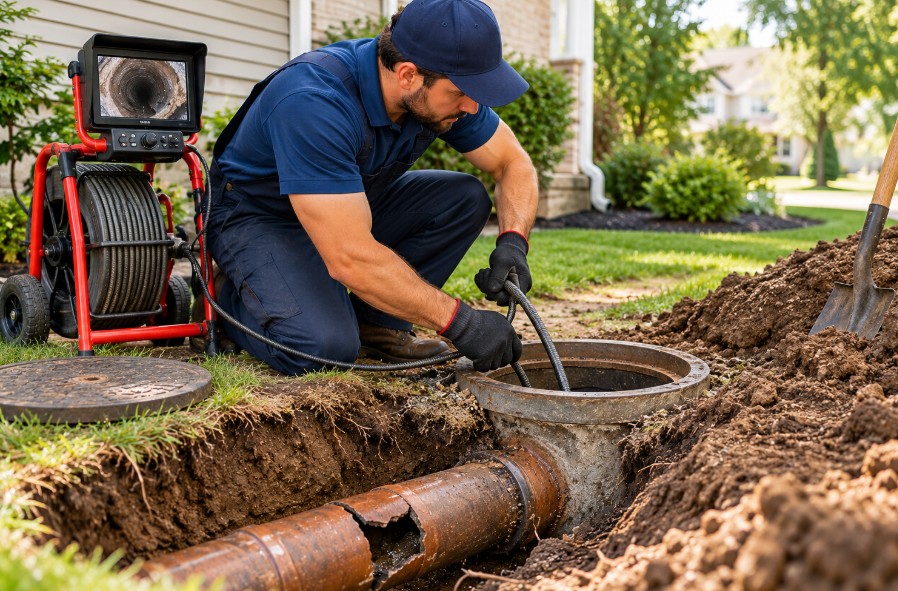
When the line between your house and the street cracks, sags, fills with roots or collapses, every drain in the house is affected. For sewer line repair in Lansing, MI, call our Lake Lansing Road office any hour. We clear the line to stop the backup, run a camera to find exactly what failed and where, and quote the smallest repair that will actually last — spot repair, lining or new pipe.
- Stop using water — no flushing, showers, laundry or dishwasher.
- Stay out of standing sewage and keep kids and pets away.
- Shut off power to the basement only if you can reach the panel without standing in water.
- Photograph the damage before cleanup. You'll need it for insurance, and for any claim against the city, which Michigan law says must be made in writing within 45 days.
- Call us. If neighbors are backing up too, also report it to your city's public works or public service department.
Signs Your Sewer Line Needs Repair, Not Just Cleaning
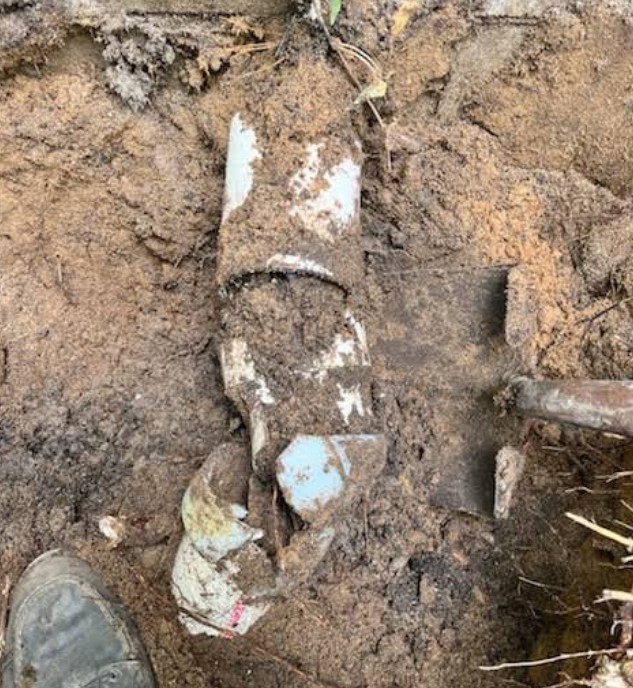
A clog can be cleared. A broken pipe keeps coming back. These point to damage in the line itself:
| What you notice | What it usually means |
|---|---|
| The main line backs up again within weeks or months of being cleaned | Roots returning through a cracked joint, or a sag (belly) holding debris |
| Several drains slow at once, especially in the basement | A blockage or partial collapse in the main line |
| Toilets gurgle when the washer or tub drains | Restricted flow pushing air back up the system |
| Sewer smell in the basement or yard with no visible clog | A crack or open joint letting gas escape |
| A soggy, sunken or unusually green strip in the lawn between the house and street | Wastewater leaking into the soil above the line |
| Cracks in the basement floor or a settling walkway over the sewer path | Soil washing into a broken pipe |
| Backups only in heavy rain or snowmelt | Groundwater getting in through cracks, or an overloaded public sewer |
| The camera shows roots, an offset joint, a crushed section, or flattened pipe | Damage that cleaning alone won't fix |
If you've had the line cleaned more than once in a year, it's time for a camera inspection. It costs far less than repeated emergency calls and tells you exactly what you're dealing with.
Why Sewer Lines Fail in Lansing
Pipe Age and Material
The typical Lansing home was built around 1959, and about a quarter of the city's houses predate 1940. What's under the yard depends on when the house was built:
| Era | Common sewer pipe | How it fails |
|---|---|---|
| Before about 1945 | Clay tile, some cast iron | Joints every few feet loosen and let roots in; clay cracks under load |
| About 1945–1972 | Clay, cast iron, and "Orangeburg" fiber pipe | Orangeburg — wood pulp and tar — softens, flattens and blisters with age; cast iron rusts and scales shut |
| 1970s onward | PVC or ABS plastic | Generally durable; problems come from poor bedding, settling or sags |
Orangeburg pipe stopped being made in the early 1970s and is now at least 50 years old wherever it's still in the ground. If your house dates from the postwar building boom, a camera inspection is the only way to know which you have.
Tree Roots
Mature trees line many older Lansing streets and yards. Roots seek the moisture leaking from clay and Orangeburg joints, grow inside, and keep growing. Cutting them out buys time; sealing the joint (lining) or replacing the pipe is the permanent fix.
Frost, Freeze and Thaw
Michigan's building code puts the frost line at 42 inches, and National Weather Service records show about 130 nights a year at or below freezing in Lansing. Older laterals laid shallow, or where the soil has settled, sit closer to the frost. Repeated freezing and thawing heaves the ground, shifts joints and opens cracks — which is why we see so many failures show up in late winter and spring.
Rain, Snowmelt and Groundwater
Older parts of Lansing still have combined sewers that carry stormwater and sewage together. The city is separating them under a long-term program, but in a hard rain the public system can surcharge. A cracked lateral also lets groundwater in when the soil is saturated in spring, adding to the load and washing soil into the pipe — the start of a sag or sinkhole.
Ground Movement and Digging
Settling soil, heavy vehicles over a shallow line, and nearby excavation can crack or offset a sewer pipe. Utility work along older Lansing streets is a reason to get a camera look if your drains change afterward.
Whose Sewer Line Is It?
| Section | Generally owned and repaired by |
|---|---|
| Pipes inside the house and under the basement floor | You |
| The lateral (building sewer) from your foundation to the street | You, in most Michigan communities — including any part under the sidewalk or street, depending on local rules |
| The public sewer main under the street | The city or township |
In the City of Lansing, sewer lines are part of the Public Service Department's system; East Lansing, Meridian Township and other neighboring communities run their own. If our camera shows the problem is in the public main, we'll stop, give you the video, and tell you who to call.
If the City's Sewer Caused the Damage
Michigan's Public Act 222 of 2001 lets a property owner claim damages from a city or township for a sewer backup only if the public system had a defect that was a substantial cause. A storm larger than the system was designed for generally doesn't count. The claim must be in writing within 45 days of discovering the backup. Keep photos, our invoice and the camera video.
Permits, Licensing and MISS DIG in Lansing
Sewer repair isn't just digging. Here's what has to happen legally, and what we take care of for you:
| Requirement | What it means | Who handles it |
|---|---|---|
| Plumbing permit | Michigan requires a permit before plumbing work starts, issued by the local enforcing agency — in the City of Lansing, the Building Safety Office; elsewhere, your township or the state. The work is inspected before the trench is closed. | We pull it and schedule inspection |
| City sewer license | Lansing's city code (Chapter 814) allows only a state-licensed master plumber registered with the city, or a licensed and insured drain and sewer layer, to repair a sewer or connect to a public sewer for hire. | Ask any contractor you're considering |
| MISS DIG 811 | Michigan law requires contacting MISS DIG at least 3 business days before any digging. Gas, electric, water and communication lines get marked; the contractor doing the work is responsible for the ticket. Within 4 feet of a mark, digging is by hand. | We file the ticket and wait for clearance |
| Your own sewer line isn't marked | MISS DIG doesn't locate private lines like your sewer lateral. | We locate it with a camera transmitter before we dig |
| Work in the street or sidewalk area | Digging in the public right-of-way needs city approval and proper restoration. | We coordinate with the city |
| Frost depth | New or replaced sewer pipe has to be protected against freezing; Michigan code uses a 42-inch frost depth. | Built into our design |
In an emergency backup, we can clear the line the same night. Digging still needs a MISS DIG ticket first. Michigan's law has a separate emergency process for genuine hazards, but most sewer excavations are scheduled once the utility lines are marked — it's what keeps a sewer repair from turning into a gas leak.
How a Sewer Line Repair Goes
- Stop the backup. If sewage is coming up, we clear the line first so the house is usable.
- Camera the line. We record the full run from the cleanout to the main, locate and mark the problem on the ground, and measure its depth.
- Show you the video and give a written quote. You see the damage yourself, with options — usually the least invasive fix that will last, and what it costs compared with a bigger repair.
- Permits and MISS DIG. We file both and wait for marks and clearance.
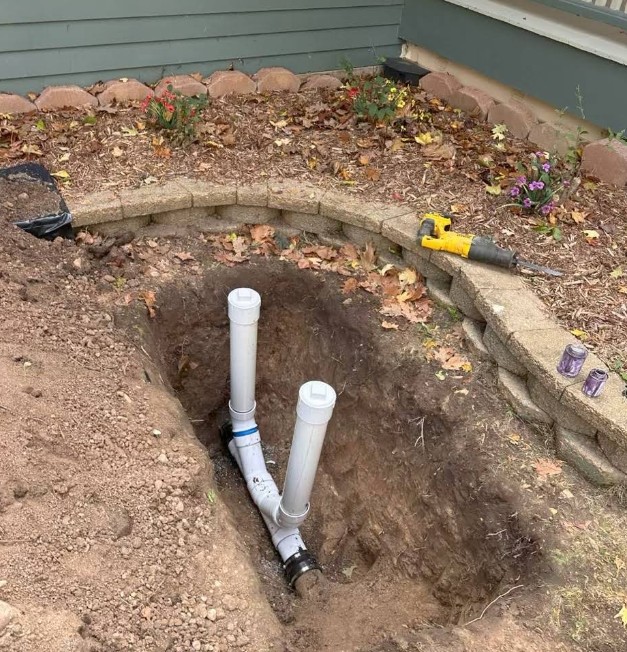
- Make the repair. Spot dig, lining, bursting or new pipe — bedded properly and set at the right slope.
- Inspect and test. The city or township inspects open work before backfill; we camera the finished line and give you the video.
- Restore the site. Backfill, compact, and rough-grade the yard; we'll tell you up front what lawn, driveway or sidewalk restoration is included.
Most spot repairs and lining jobs are done in a day. A full replacement with excavation usually takes one to three days, depending on depth, length and what's in the way.
What Sewer Repair Costs Depend On
We give you a written price after the camera inspection, not before — any number quoted sight unseen is a guess. What moves the price:
Insurance
Michigan's insurance department says a typical homeowners policy doesn't cover sewer backup damage unless you've added a backup endorsement. Repairing the broken pipe itself is a separate question — some insurers sell service-line coverage for that. Check your policy, and keep our camera video and written diagnosis for any claim.
City of Lansing B2P2
If your Lansing home has flooded from the public sewer backing up, the city's Basement Backup Protection Program may reimburse part of a backwater valve or sump system installed with a permit and city inspection — up to $4,750 as of 2026. It doesn't pay for lateral problems like roots or broken pipe, but if we're already repairing your line, adding a backwater valve at the same time is often the most economical moment to do it. Check eligibility with Public Service at (517) 483-4456 before work starts.