
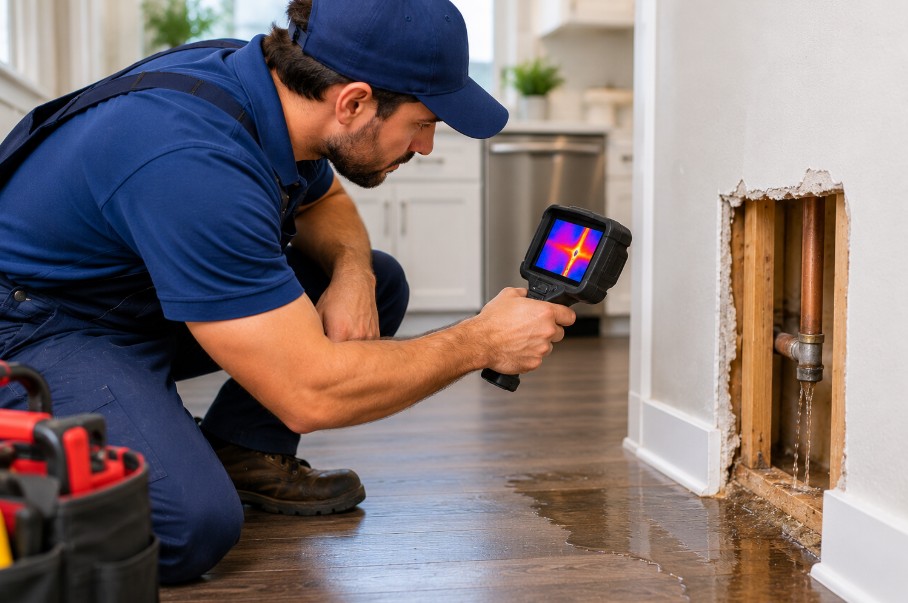
Leak Detection Service in Lansing, MI — Find the Leak Before You Open a Wall
A water bill that suddenly doubles, a ceiling stain that keeps growing, the sound of water running when every tap is off — the leak is somewhere, but tearing out drywall to guess where costs more than the leak. Our leak detection service in Lansing, MI uses pressure testing, acoustic listening and thermal imaging to pinpoint hidden leaks in walls, ceilings, floors and buried water lines. Then a licensed plumber fixes it through the smallest opening possible. Active leak? We answer 24/7.
- Close the main shut-off. In most Lansing homes it's in the basement where the water line comes through the foundation, right at the water meter. Lansing Board of Water & Light (BWL) rules require a customer valve on the outlet side of the meter — that's the one you turn.
- Kill power to wet areas at the breaker if you can do it without standing in water. Never touch a light fixture with water dripping from it.
- Open a faucet on the lowest floor to drain pressure off the pipes.
- Photograph everything — the stain, the water, the ceiling — before you clean up.
- Call us. We'll find the source even after the water is off, by pressurizing one section at a time.
Signs You Have a Hidden Leak
The EPA estimates the average household's leaks waste more than 9,300 gallons a year, and that about 9% of homes have leaks wasting 50 gallons or more every day. Most of them make one of these signs:
Do the Meter Test First (Free, 2 Hours)
This tells you whether water is leaving the pressurized pipes at all — before you pay anyone.
- Turn off every faucet, the washer, dishwasher, ice maker, softener and irrigation. Don't flush.
- Write down the reading on your water meter.
- Wait two hours without using any water, then read it again.
- Any change means a leak on your side of the meter.
BWL customers can also look at their usage history: BWL's smart meters report water use daily, so a leak shows up as usage that stays high every day — including days the house was empty.
Then the Toilet Dye Test (10 Minutes)
Put a few drops of food coloring in each toilet tank. If color appears in the bowl within 10 minutes without flushing, the flapper is leaking. Toilets are the most common silent leak we find, and the EPA notes a stuck fill valve alone can waste thousands of gallons a day.
If the meter moves and the toilets pass, the leak is hidden. That's when you call us.
How We Find Leaks
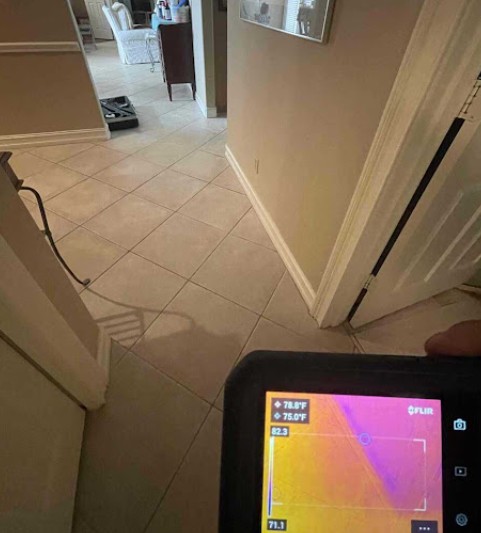
No single tool finds every leak. We start with the least invasive test that can narrow it down, and add tools until we can mark the spot.
| Method | What it does | Best for |
|---|---|---|
| Meter and isolation testing | Shut sections of the plumbing off one at a time and watch the meter or a gauge | Telling us whether the leak is in the buried service line, the hot side, the cold side, or one branch |
| Pressure testing | Pressurize an isolated line and watch for a drop | Confirming a leak in a line you can't see; checking a repair |
| Acoustic listening | Ground microphones and contact sensors pick up the hiss of water escaping under pressure | Leaks under floors, inside walls and in buried water lines |
| Thermal imaging | An infrared camera shows temperature differences — a leaking hot line shows warm, a wet ceiling shows cool | Hot-water leaks, radiant heat lines, wet spots behind drywall and ceilings |
| Moisture meters | Measure moisture in drywall, wood and subfloor | Mapping how far the water has spread, and confirming it's dry after repair |
| Tracer gas | A safe gas is put into an empty line and detected where it escapes | Very small leaks that are too quiet to hear |
| Sewer and drain camera | A waterproof camera runs through drain lines | Leaks from drains, tub and shower drains, and sewer lines — which don't show on the water meter |
| Line locating | An electronic transmitter traces the path of buried pipe | Finding where a water or sewer line actually runs before anyone digs |
Supply Leak or Drain Leak?
This matters because the water meter only sees the pressurized supply side. A leaking shower drain or a cracked waste line under a bathroom floor won't move the meter at all — it only leaks when that fixture is used. If your meter test passes but a ceiling still stains after showers, we test the drains and the shower pan instead of the supply lines.
Where Leaks Hide — and Why
| Location | Common cause | What you usually notice |
|---|---|---|
| Toilets | Worn flapper or a fill valve that won't shut off | Tank refilling on its own, higher bill, nothing visible |
| Supply lines to toilets, faucets, washer, ice maker | Cracked plastic nuts, aging rubber hoses | Water under a cabinet or behind an appliance |
| Water heater | Corroded tank, leaking relief valve or fittings | Water at the base, rust, a heater that runs constantly |
| Pipes inside walls and ceilings | Pinholes in old copper, rusted-through galvanized, frost damage in outside walls | Stains, bubbling paint, sagging drywall |
| Shower valves and drains | Failed valve cartridge, cracked drain, failed shower pan | Ceiling stain below the bathroom after showers only |
| The buried water service line | Age, ground movement, frost | Wet ground between the street and the house, wet basement wall where the line enters, low pressure |
| Under basement floors and slabs | Corroded or damaged pipe below concrete | Damp floor spot, warm patch over a hot line, sound of running water |
| Boilers and radiant heating loops | Old fittings, corroded pipe | Boiler pressure dropping, frequent refilling, warm spots on floors |
| Outdoor faucets and irrigation | Frozen and split pipe inside the wall; frost-damaged sprinkler lines | Water in the basement after the hose is first used in spring; a high bill in May |
| Sump pump and drain connections | Cracked discharge or drain pipe | Water around the pit or along the foundation |
Leak Detection in Lansing: What's Different Here
BWL Owns More of the Line Than Most Utilities
Under the Lansing Board of Water & Light's water rules, BWL furnishes, owns and maintains the customer water service — the pipe from the water main in the street to your meter. Your responsibility starts at the outlet of the meter. That's unusual; in many cities the homeowner owns the buried line from the curb. So in BWL territory:
| Where the leak is | Who fixes it |
|---|---|
| Water main, curb stop, or the buried line before the meter | BWL — call (517) 702-6490 for water main breaks and service problems |
| The meter itself, or its fittings | BWL (you may be charged if it was damaged, for example by freezing) |
| Anything after the meter — the outlet valve and every pipe in the house | You, and us |
Only BWL is allowed to operate the curb stop outside; opening it yourself counts as tampering and carries a fee. If our isolation test shows the leak is upstream of your meter, we'll stop, document it, and tell you to call BWL instead of paying us to dig.
In East Lansing, Meridian Township and other surrounding communities, the rules belong to that community's water system. We'll check before we recommend anything.
Lansing Meters Are Usually Inside, Near the Foundation
BWL's rules call for the meter to be inside the building, as close as practical to where the water line comes in, in a heated space with a floor drain nearby. That makes the meter test easy — and it also means the most common place we find a leak on the service side is right at that foundation wall. A wet patch on the basement wall around the incoming line points to the service pipe, the meter fittings, or the seal through the foundation.
A Leak Is Billed Twice
In the City of Lansing, sewer charges are calculated from the water you use. Every gallon a hidden leak wastes is billed as water and again as sewer — even though it never went down a drain.
Not Sure the Meter Is Right?
BWL will test your meter on request. If it reads within plus or minus 1.5%, there's a calibration charge; if it's outside that range, BWL repairs or replaces it and refunds the charge. If the meter test and our inspection find no leak, a calibration check is the logical next step, and BWL's rules allow billing errors to be corrected.
Older Homes, Older Pipe
The typical Lansing house was built around 1959, and about a quarter of the city's homes predate 1940. That means a lot of galvanized steel and decades-old copper inside walls. BWL itself notes that discolored water at just one faucet usually means rusting galvanized pipe in the house — the same pipe that eventually rusts through and leaks behind the wall.
Winter Leaks Show Up Late
Lansing sees about 130 nights a year at or below freezing. A pipe that froze in an outside wall in January may not leak until it thaws, and an outdoor faucet that split inside the wall often isn't discovered until the hose goes on in April. BWL also charges for replacing a meter damaged by freezing, so keep the meter area heated.
Our Leak Detection Process
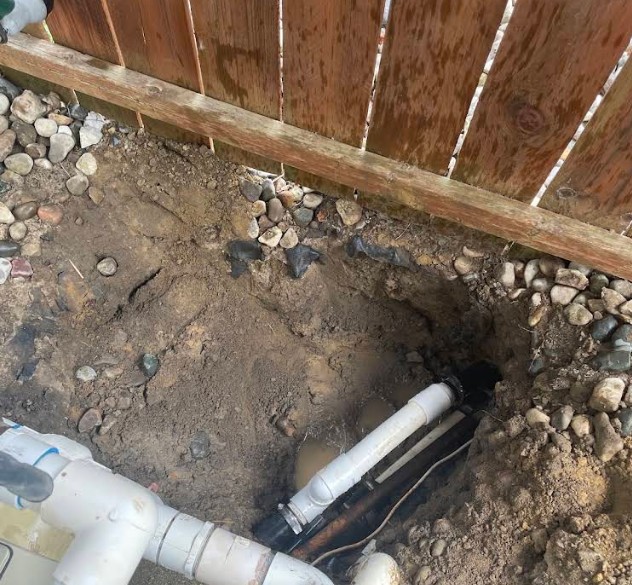
Precision Diagnostics from Arrival to Repair
A systematic seven-step methodology to pinpoint hidden water leaks without unnecessary destruction to your home or yard.
Start on the phone. We ask what you've noticed, when it started, and whether the meter test moved. That tells us which equipment to bring.
Confirm and isolate. At the house we check the meter, then shut off sections — the house valve, hot side, cold side, individual branches — to narrow the leak to one part of the system. If the meter keeps moving with your house valve closed, the problem is between the meter and the valve, or is BWL's to handle.
Pinpoint. Acoustic listening, thermal imaging, moisture mapping, tracer gas or a drain camera, depending on what the isolation test showed.
Mark the spot and show you. You see the readings or the image, and we mark the location on the wall, floor or ground.
Quote the repair. You get a written price for the repair, including how big an access opening is needed.
Repair through the smallest opening. Usually a section of drywall about the size of a shoebox or an access panel — not a whole wall.
Prove it's fixed. We repeat the meter or pressure test after the repair, and give you a written summary with photos of the cause and the moisture readings — the documentation insurers ask for.
Most homes take one to three hours to locate a leak. Leaks under concrete, in long buried lines or behind finished stone can take longer.
After We Find the Leak
Repair Options
| Situation | Usual fix |
|---|---|
| One failed fitting or pinhole in otherwise good pipe | Cut out and replace that section |
| Leak under a concrete floor | Repair through a small cut in the slab, or reroute the line overhead or through a wall and abandon the old run |
| Galvanized or old copper that's leaking in several places | Replace the run, or repipe the house in stages, starting with the worst section |
| Leaking shower valve or drain | Replace the cartridge, valve or drain; test the shower pan |
| Toilet, faucet, supply line or appliance hose | Replace the part — often the same visit |
Insurance in Michigan
Michigan's insurance department says homeowners policies generally cover sudden water damage — water "from the top down," like a burst pipe — while seepage from below and sewer backup usually aren't covered without an endorsement. A slow leak that went on for months is also commonly excluded as wear and tear. Coverage for the cause and the damage can differ, so call your agent early. We give you what an adjuster typically asks for: the cause, the location, photos, moisture readings and the date we found it.
Catching the Next Leak Early
Leak Sensors and Automatic Shut-Offs
The EPA's WaterSense program groups these into two kinds:
| Type | Where it goes | What it does |
|---|---|---|
| Point-of-use moisture sensors | On the floor by the water heater, washer, dishwasher, under sinks and near the sump | Alarm or phone alert the moment they get wet |
| Point-of-entry flow monitors and shut-off valves | On the main water line just after the meter | Learn your normal use, alert you to continuous flow, and can shut the water off automatically |
A whole-house shut-off valve on the main is the one that saves a basement when you're away for a weekend in February. The EPA notes these devices can also lower insurance premiums with some insurers — ask yours. We install both kinds and set them up on your phone.