
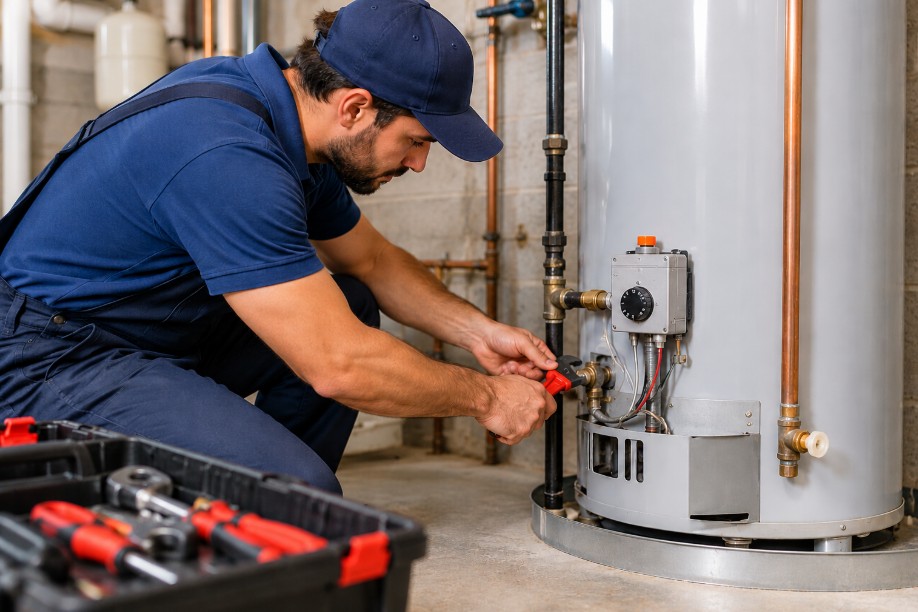
Water Heater Repair in Lansing, MI — Emergency 24/7
A cold shower in January, a puddle spreading from the base of the tank, a pilot light that won't stay lit. When your water heater quits, our Lansing office picks up at any hour and sends a licensed plumber with a truck stocked for water heater repair in Lansing, MI. Most homes have hot water again the same day, and you get a clear price before any work starts.
- Gas, electric, tankless and power-vent — all major brands
- 30–90 minute emergency arrival — from our Lake Lansing Road office
- Upfront quote — repair or replace, you decide
- Licensed & insured — permits pulled when the job needs one
Signs Your Water Heater Needs Repair — and How Urgent Each One Is
Most water heater trouble announces itself before the tank gives out. The table below is how we triage calls on the phone, so you know whether to call tonight or book a same-day visit.
| What you're noticing | What it usually means | How urgent |
|---|---|---|
| Water pooling under the tank or dripping from the bottom | The tank itself has corroded through. Tanks can't be patched. | Emergency — shut off the water and call now |
| Water at a pipe fitting, the drain valve or the T&P discharge pipe | A loose connection, worn drain valve, or a relief valve releasing pressure | Same day; the T&P valve is urgent if it keeps discharging |
| No hot water at all (gas) | Pilot out, failed thermocouple or flame sensor, bad gas control valve, or a blocked vent | Same day; emergency with vulnerable people at home |
| No hot water at all (electric) | Tripped breaker, failed element, or a thermostat or high-limit switch that tripped | Same day |
| Hot water runs out much faster than it used to | Sediment taking up tank space, a failed lower element, or a broken dip tube | Same day or next day |
| Popping, rumbling or crackling | Sediment and mineral scale cooking on the tank bottom | Schedule soon; it shortens tank life |
| Rusty or brown hot water (cold is clear) | The anode rod is spent and the tank lining is rusting | Schedule soon; replacement may be close |
| Rotten-egg smell from the hot side only | The anode rod reacting with the water; usually fixed with a different anode | Not urgent, but worth fixing |
| Rotten-egg smell near the heater or anywhere in the house | Possible gas leak | Leave the house and call Consumers Energy and 911 first |
| Water scalding hot or temperature swinging | Failed thermostat or gas control; scalding is a safety issue | Same day |
| Tankless unit flashing an error code or shutting off mid-shower | Scale in the heat exchanger, a dirty inlet filter, venting or ignition fault | Same day |
Water Heater Repair Services in Lansing, MI
We repair every common type of residential water heater you'll find in Lansing basements and utility closets. Our trucks carry the parts that fail most often, so the repair usually happens on the first visit.
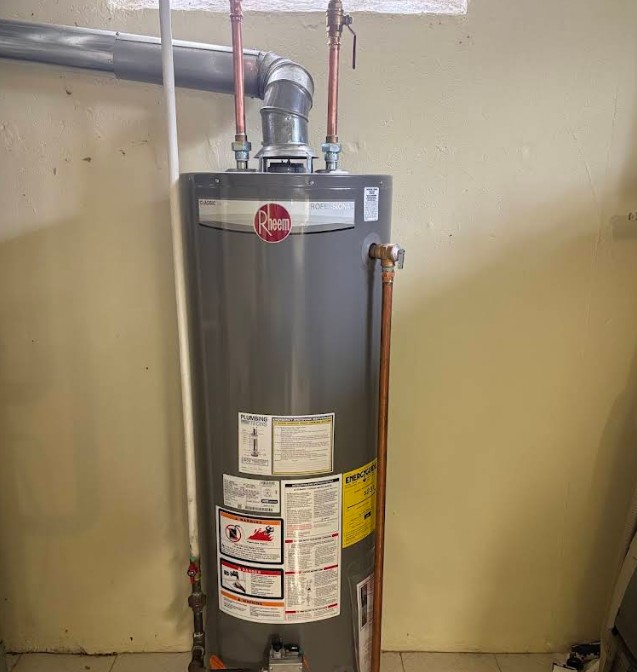
Gas Tank Water Heaters
The most common setup in Lansing, since most homes here run on Consumers Energy natural gas. We replace thermocouples and flame sensors, gas control valves, burner assemblies, igniters and dip tubes, and clear blocked flues. We also test draft at the vent, because a heater that spills exhaust into the basement is a carbon monoxide risk, not just a hot-water problem.
Electric Tank Water Heaters
Common in condos, apartments and homes without gas service. We test and replace upper and lower heating elements, thermostats and high-limit (reset) switches, and check the wiring and breaker. A burned-out lower element is the classic reason an electric heater runs out of hot water halfway through a shower.
Tankless Water Heaters
We service gas and electric tankless units, including error-code diagnosis, inlet filter cleaning, flame rod and igniter replacement, flow sensor faults and venting problems. Scale is the main enemy of a tankless heat exchanger, so most tankless repairs include a descaling flush with an isolation valve kit if your unit doesn't have one.
Power-Vent and Direct-Vent Heaters
These use a fan and plastic vent pipe out the side or roof of the house. We repair draft inducer motors, pressure switches and control boards, and clear vent terminations that snow, ice or a bird's nest have blocked.
Heat Pump (Hybrid) Water Heaters
We repair compressor-side faults, clogged condensate lines, dirty air filters and sensor errors, and switch the unit to backup electric mode so you have hot water while a part is on order.
Indirect Water Heaters and Combi Boilers
Many older Lansing homes heat with boilers, and some make hot water through a storage tank connected to the boiler. We diagnose the zone valve, circulator, aquastat and tank coil, and coordinate with the boiler side so both systems work together.
Valves, Fittings and Safety Parts
We replace leaking drain valves, failed temperature-and-pressure (T&P) relief valves, corroded water connectors, shut-off valves, and anode rods. Where the plumbing calls for it, we add a thermal expansion tank so pressure doesn't keep tripping the relief valve.
How Lansing Water and Weather Wear Out Water Heaters
A water heater in Lansing has a harder job than the same model in a mild climate. Here's what local conditions do to it, and what we do about each one.
Hard Water, Even After Softening
Which water you have depends on where you live, and both are hard at the source.
| Your address | Your water comes from | How it's treated | Hardness at the tap |
|---|---|---|---|
| Lansing, plus parts of Lansing, Delhi, DeWitt, Bath, Watertown and Delta townships | Lansing Board of Water & Light — 124 wells about 400 ft deep in the Saginaw Aquifer | Softened at two plants, removing roughly 80–85% of the hardness | About 100 mg/L (≈5.7 grains per gallon) |
| East Lansing and Meridian Township (Okemos, Haslett) | East Lansing–Meridian Water & Sewer Authority — about 29 wells, also around 400 ft deep | Lime-softened, removing about 65% of the hardness | About 110 mg/L (≈6.4 grains per gallon) |
| Private wells in outlying areas | Your own well | Only what your softener does | Often much harder |
Even softened water leaves minerals behind. BWL notes that calcium carbonate from the softening process settles out inside water heaters. That layer is the popping and rumbling you hear, and it insulates the burner from the water, so the heater burns more gas for the same shower. On tankless units it coats the heat exchanger and triggers flow and overheat errors. On a private well with no softener, scale builds much faster.
The Anode Rod and the Rotten-Egg Smell
Every tank has a sacrificial anode rod that corrodes so the tank doesn't. BWL recommends magnesium anodes over aluminum for its water, and points to the anode when hot water (but not cold) smells like rotten eggs. Once the anode is gone, the tank lining starts to rust, which is when you see brown hot water and, eventually, a leak.
Cold Winters Mean Longer Recovery
National Weather Service records for Lansing show January averaging a low around 17°F, about 130 nights a year at or below freezing, and roughly a week of below-zero mornings each winter. Colder incoming water means the heater has to raise the temperature further, so it runs longer, works harder and recovers more slowly between showers. A heater that was barely keeping up in October often gives out in January, and a weak element or burner that limped along all fall tends to quit in the first cold snap.
Snow and Ice on Side-Wall Vents
Lansing averages about 50 inches of snow a year. Power-vent, direct-vent and tankless heaters exhaust through plastic pipes on the side of the house, often close to the ground. Drifting snow, ice from a roof line or a plowed-up snowbank can block the termination, and the heater shuts itself off as a safety measure.
Flooded Basements
Most Lansing water heaters sit on a basement floor, and spring storms and thaws can put water on that floor. If water reaches the gas control valve, burner or flame arrestor, don't relight it. Appliance manufacturers advise that flood-soaked gas controls be replaced, not dried and reused, because corrosion can make them fail dangerously later — and on many sealed-combustion tanks, a wet flame arrestor means the whole heater has to be replaced.
Power Outages
Tankless heaters, power-vent tanks and heat pump water heaters all need electricity, so they stop making hot water when the power goes out. Older atmospheric-vent gas tanks with a standing pilot usually keep working. If you lose hot water after an outage, check whether power is back on before you call — some units need a manual reset once power returns.
Never run a generator inside the house or garage to keep a water heater going. After an August 2023 storm left thousands of BWL customers without power, the Lansing Fire Department answered more than a dozen carbon monoxide calls in one weekend, and two people died from a generator run indoors. The department recommends generators at least 20 feet from the house, and CO alarms outside every sleeping area and on every level — including the basement where your gas water heater sits.
Emergency Water Heater Repair in Lansing: What to Do Before We Arrive
A few safe steps can stop the damage and help us fix the problem faster. Do only what you're comfortable doing.
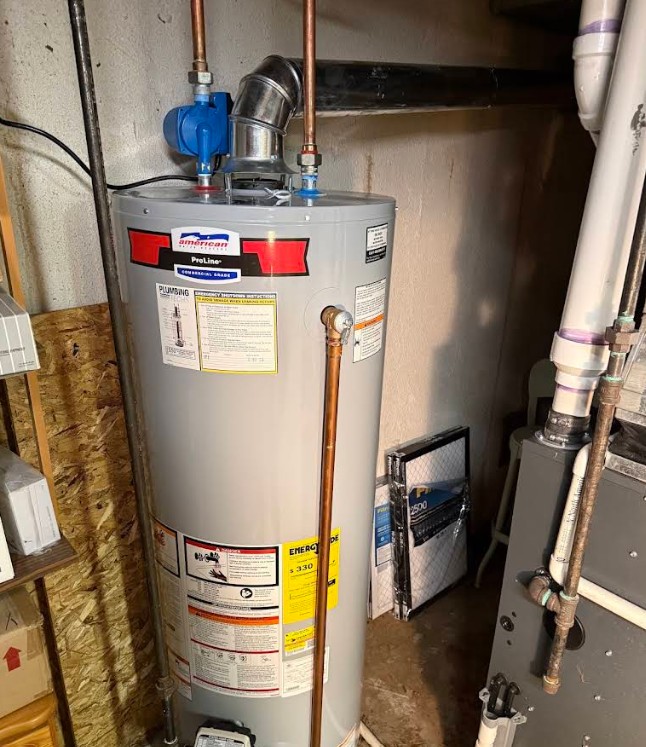
If the Tank Is Leaking
- Close the cold-water inlet valve on top of the heater (turn clockwise). If it's stuck or the leak is fast, shut the main water valve where the line enters your basement.
- Shut off the energy source: set a gas control to "Pilot" or "Off," or turn off the breaker for an electric or heat pump unit.
- Move boxes and anything on the floor away from the heater, and use towels or a wet vac to keep water from spreading.
- Don't drain the tank yourself unless you know how — the water inside can be hot enough to scald.
If You Have No Hot Water
- Electric: check the breaker. If it tripped again right after you reset it, leave it off and call.
- Gas: look through the sight glass for the pilot or burner flame. If the heater has relighting instructions on the label and you're comfortable following them, try once. If the pilot won't stay lit, call — it's usually the thermocouple or gas valve.
- Tankless or power-vent: check that the unit has power and that the vent outside isn't blocked by snow. Write down any error code on the display.
If You Smell Gas
Leave the house right away. Don't flip light switches, use the phone inside or try to find the leak. From outside, call 911 and Consumers Energy's 24-hour line at 1-800-477-5050. Once the utility says it's safe, we'll repair the gas connection and the heater.
If Water Is Spraying From the Relief Valve
The T&P relief valve is doing its job: the tank is too hot or over-pressured. Turn off the energy source, keep clear of the discharge pipe, and call. Never cap or plug a relief valve.
If the Heater Was in Flood Water
Leave the gas and power off and don't relight it. Take photos of the water line on the tank for your insurance claim, and call us to inspect it before it's used again.
Repair or Replace? An Honest Answer
We repair first whenever it makes sense. A worn-out thermocouple shouldn't turn into a new water heater. But putting money into a tank that's about to fail doesn't help you either. Here's how we make the call with you.
| Your situation | What we usually recommend |
|---|---|
| Tank under about 8 years old, failed part (thermocouple, element, thermostat, gas valve, drain valve) | Repair |
| Tank leaking from the body or bottom, any age | Replace — a corroded tank can't be repaired |
| Tank 10–12+ years old with rusty hot water or loud rumbling | Replace soon; plan it before it fails |
| Second or third repair in a year on an older tank | Usually replace |
| Tankless unit under 15 years old with scale or sensor errors | Descale and repair |
| Heater was submerged in flood water | Inspect; replace flood-soaked controls, often the whole unit |
| Household has outgrown the tank (new baby, more people, bigger tub) | Consider upsizing, a high-recovery model or tankless |
If replacement is the better choice, we'll explain the options — same-size tank, high-efficiency gas, tankless or heat pump — with the price of each before you decide. If you just want hot water tonight, we can usually replace a standard 40- or 50-gallon tank the same day.
How Our Water Heater Repair Works, From Call to Hot Water
You call, a person answers.
Our Lansing office picks up at any hour. We ask what you're seeing, walk you through shutting off water or gas if needed, and ask for the brand and age of the heater if you can find it.
A licensed plumber heads your way.
Most Lansing addresses see us in 30 to 90 minutes for emergencies. You get the plumber's name and a real arrival time.
We find the actual cause.
We check the burner or elements, controls, venting and draft, relief valve, anode and the tank itself — not just the part that failed, but why it failed.
You get a price before any work.
Repair and, if it's worth considering, replacement — both priced upfront. You choose.
We fix it, test it and clean up.
We confirm safe venting and temperature, check for leaks, and haul away old parts. If the job needs a permit, we file it and schedule the inspection.
We tell you what to watch for.
Age of the tank, condition of the anode, and when the next flush is due — so the next failure doesn't surprise you.