
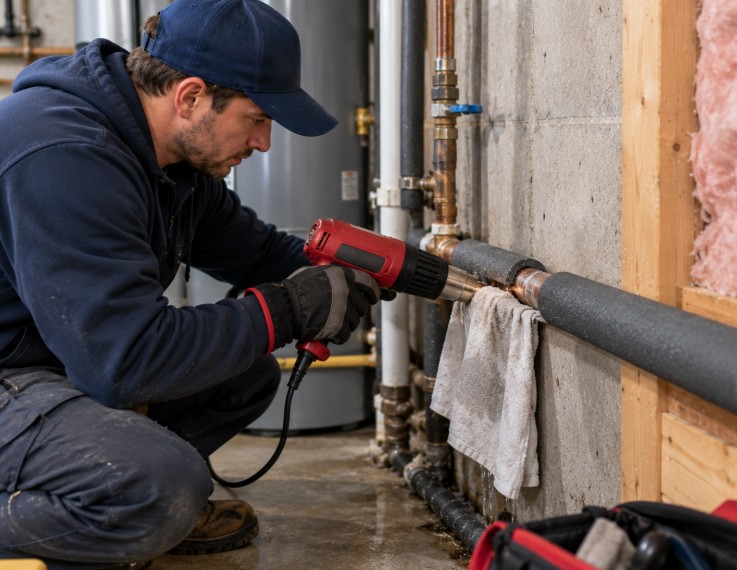
Frozen Pipe Repair in Lansing, MI
A faucet that coughs out a trickle on a subzero morning means ice has closed off a pipe somewhere between the street and that tap. The ice itself isn't the expensive part; the split it hides is, and it starts leaking the moment the pipe warms up. We find the frozen section, thaw it with controlled heat instead of flame, check the pipe for cracks before full pressure comes back, and fix whatever let the cold reach it.
When the Ice Is at the Meter or the Service Line
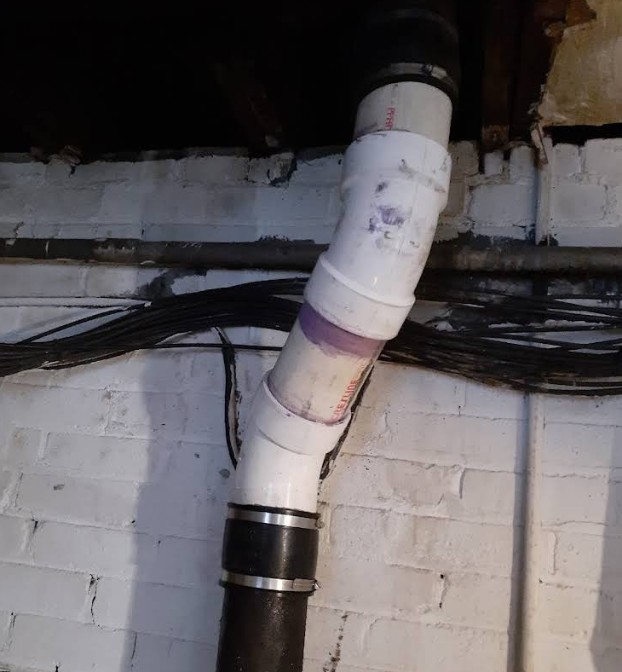
No water at any tap usually means the freeze is at the front of the house: in the line coming through the foundation, at the water meter, or in the main valve beside it. In the Lansing Board of Water & Light (BWL) service area, who handles it depends on exactly where the ice is.
What BWL's own rules say about cold:
- The meter must sit in a space with adequate ventilation and permanent heat to keep it and its piping from freezing. Providing that space is the customer's responsibility.
- If a meter freezes, BWL may charge the customer to replace it. Its 2024 fee schedule lists $305 for a standard residential meter.
- If BWL has asked customers to keep water running during a cold spell and a service freezes anyway, BWL lists a thawing charge starting at $290.
- Before BWL turns water back on to a house, the customer has to confirm the plumbing is intact and the house is heated.
In practice: keep the corner where the water comes in warm. Don't block the basement's heat from reaching it, and seal drafts around the pipe at the rim joist. If BWL issues a run-water request during a cold snap, follow it.
Not on BWL water? On East Lansing city water, where the meter is in an outdoor pit, or on a private well, the frozen line is usually the owner's responsibility. Call us first.
How We Thaw and Repair Frozen Pipes
Finding the Ice
We work back from the fixtures that still run toward the ones that don't, which narrows the freeze to one stretch of pipe. An infrared thermometer or thermal camera then shows the cold spot through a wall or ceiling, so we open the smallest possible access point instead of guessing.
Thawing It Without Making It Worse
The method depends on the pipe and where it is:
| Situation | How we thaw it |
|---|---|
| Exposed copper or PEX in a basement, cabinet or crawl space | Controlled hot air, heat pads or heat lamps, starting at the open faucet and working toward the ice |
| Pipe inside a finished wall or ceiling | Warming the cavity through a small opening, or temporary heat aimed into the space, while we watch for leaks below |
| Long buried or plastic line you own, such as from a meter pit, a detached garage or a well | A hot-water thawing machine that feeds a small tube into the pipe and melts the ice from the inside |
| Metal pipe where the ice can't be reached | Electric pipe-thawing equipment that warms the pipe itself. This is metal pipe only, never plastic, and in trained hands only. |
Checking for Splits Before Full Pressure Comes Back
The damage from a freeze usually isn't where the ice was. Ice forms a plug, and the water trapped between that plug and a closed faucet is what gets squeezed until a fitting or a seam gives out. So once water flows, we bring pressure back gradually and check the whole frozen run, not just the warm spot. If the pipe has already split and is spraying, our Burst Pipe Repair page covers that response.
Fixing It and Fixing Why
- One split in sound pipe: cut out the damaged section and replace it with new copper or PEX.
- Several splits, or old galvanized pipe that froze: replace the whole exposed run. Patching failing pipe one freeze at a time doesn't hold.
- A line that freezes every winter: move it inside the heated envelope, insulate the wall cavity in front of it, or add UL-listed heat cable where rerouting isn't practical.
- Drafts at the rim joist or around penetrations: seal them. That's often the real fix.
What Affects the Cost
- How many places froze, and whether any burst
- Access: an open basement pipe versus a finished wall or a crawl space
- Pipe material and how much needs replacing
- Whether rerouting or insulation work is needed to stop it happening again
You get the price for the thaw and any repair before we start, and a separate price for prevention work so you can decide on it later.
Keeping Pipes From Freezing
Once, Before the First Hard Freeze
- Disconnect every garden hose. Close the inside shut-off to each outdoor faucet, then open the outdoor faucet and leave it open so trapped water can drain or expand. The Red Cross recommends exactly this.
- Drain lawn irrigation lines the way the installer specifies. Don't add antifreeze unless they tell you to.
- Insulate exposed pipes in the garage, crawl space and attic, and under sinks on outside walls. Use foam sleeves, or UL-listed heat cable on the worst runs.
- Seal drafts where pipes and the water service pass through the rim joist and foundation.
- Check crawl-space vents, skirting on manufactured homes, and any torn insulation.
When the Weather Service Issues a Cold Alert
- Keep the thermostat at the same setting day and night. The Red Cross advises skipping the nighttime setback during severe cold.
- Open cabinet doors under sinks on outside walls, and keep the garage door closed.
- Let a thin stream of cold water run at a faucet served by exposed pipes. It helps, though plumbers interviewed by WILX cautioned that dripping alone isn't a guarantee in the worst cold.
- Check the basement corner where the water comes in. Is it getting the furnace's heat?
If You'll Be Away
- Leave the heat on, no lower than 55°F (the Red Cross's minimum).
- Have someone check the house, or install a Wi-Fi thermostat or temperature sensor that texts you if the house cools down.
- For a long absence, have the plumbing drained and winterized. On BWL water, a temporary shut-off for winterization carries a reconnection fee, and the monthly basic service charge continues.
Landlords and Property Managers
- Empty units between tenants are a weak spot: no one is watching the thermostat.
- BWL requires landlords to enroll rentals in its Automatic Leave-On service, which keeps utilities in the owner's name between tenants instead of shutting off. That keeps the furnace powered in an empty unit.
- Walk vacant units during every cold alert, or put temperature sensors in them.
Frozen Pipes and Your Insurance
Most homeowner policies cover sudden water damage from a pipe that freezes and bursts. Many also carry a freezing exclusion: if the home was vacant, unoccupied or under construction, the freeze isn't covered unless the owner kept the heat on, or shut off the water and drained the system.
A Michigan case shows how literally that wording can be read. In Kennedy v. Auto-Owners (Michigan Court of Appeals, 2011, unpublished), an empty house had furnaces set to 55°F, a temperature-monitoring alarm, regular owner visits and extra insulation, yet two pipes froze and burst. The court said the policy required precautions to actually maintain heat, which means a working heat source. Monitors and visits only tell you when the heat has failed. Whether the propane had run out became the deciding question, and the case went back for trial on it.
What that means for you:
- Find the freezing exclusion in your full policy, not just the declarations page, and see how it defines "vacant" and "unoccupied."
- If a property will sit empty, either keep it heated, fueled and checked, or have it professionally drained and winterized, and keep the invoice.
- If a pipe freezes and bursts, photograph the damage before cleanup, keep our repair report showing where and why it froze, and call your agent the same day.
This is general information, not legal advice. Your policy wording controls.